Wednesday, 10 April 2019

Race Roster Spring Run Off 2019


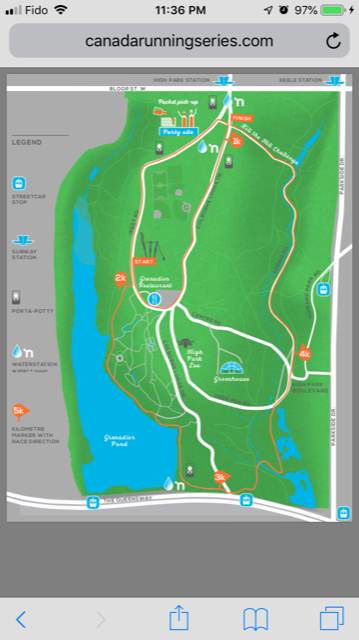
A true sign of spring in Toronto is when the Canada Running Series event, the Race Roster Spring Run-off happens in High Park in early April. This is a favourite event for me and my clients, as it is a wonderful opportunity to test our early season running fitness that we have been working on over the winter.  This year the event fell on Saturday, April 6th, 2019.

The weekend before the race, we gathered in High Park to go over the route, practice hill strategy, pacing and have a sociable group run outside in the park. After all, the treadmill gets boring after the long Canadian winter, so it was about time to gather the crew for an outdoor run. Despite the late season wet snowfall, we braved the slush for a fun route familiarization run. 


This event has 2 options for runners: the 5K and 8K courses.  This year both Alice and Juliane returned for the 8K event, while new comers to this event, Erica, Maxime and Suneethi toed the line for the 5K event.  

The weather was much better on race day - no snow, rain or sleet this time! The sun was shining and jackets were shed for the run.  

Being the supportive coach that I am, I was waiting for all the runners on the infamous Kill the Hill section of the course, ready to encourage them on through the toughest part of the race route.  No doubt about it, High Park has some challenging terrain with lots of rolling hills and a steep climb to the finish line.  But we had prepared for the terrain on the scouting run the weekend before, and nobody quit on the hill, as promised.  The entire run crew climbed that hill strong and steady making their coach proud.  

The 8K runners went first @ 10am. Juliane finished in 52:09 and Alice finished in 53:01 (placing 4th in her AG).   


The 5K runners went next @ 11:15am.  Erica finished in 26:59 (placing 7th in her AG), Maxime finished in 31:31, and Suneethi finished in 34:36.   Of all 5 runners, Erica won our own Kill the Hill challenge, finishing the climb in 2:23, a mere 7 seconds ahead of Mad Max!  A thrilling surprise to the finish.    


Overall, it was a great day out for all of us, and the tone has been set for a summer full of further run training that will include more speed and endurance work for this run crew.  I am looking forward to more runs with these inspirational ladies.  

Want to join us? Leave me a comment below or send me an email, and I’d be happy to help you with your running skills.

Wednesday, 20 February 2019

Do you have tight glutes? This blog can help.


Do you use a lacrosse ball for myofascial release? You should! Here’s why and how to. 


Its that time of year again.  The off-season for runners has ended and most of us have begun training for our spring races.  Here in the GTA many runners are eyeing the Chilly half-marathon in March, High Park Spring Run-off in April and the GLF Toronto marathon events in May.  We are a few weeks into our training plans by now and the increase in daily mileage and intensity is beginning to take a toll on the muscles of our legs, hips and glutes.
      
To manage this muscle soreness the use of a foam roller is often employed as a form of self-myofascial release (self-massage). This seems to work well on the longer muscles of our legs (e.g. quads, hamstring, calves), but not quite as well on the smaller muscles of the hip and glutes.  There are several key muscle groups in your gluteal deltoid that can be hard to release with a foam roller alone, and left untreated can lead to back, hip and the general pain in the butt nuisances we all have dealt with at some point. 


Your gluteal deltoid is made up of your gluteus maximus, gluteus medius, and gluteus minimus. The glute max is your main powerhouse muscle, while the glute med and glute min are very important for stabilization and proper form.  A runner who wants to perform well and remain injury free will need to strengthen and stretch all of these muscle groups.  Exercises like squats, banded bridges and clams will activate these muscles groups, but when they become sore and tight sometimes stretching alone is not enough for gluteal recovery, and the foam roller is awkward to use in this region of your body. This is where the lacrosse ball comes into play. 


The lacrosse ball is small, round and dense - the perfect size and shape for getting into the curves and trickier parts of your gluteal regions.  For best technique, I like to stand next to a wall, press the lacrosse ball into the desired portion of my glutes and gently work in circles until the trigger-point knot is found.  This may be intense at first, especially if you’re sore and have never done this before, so vary the time and pressure of the massage to a point you can manage.    


Its important to work the entire gluteal region, noticing the different areas where the glute med and min extend around to the outer/lateral region of the glute. This area is often overlooked with too much focus spent on the larger glute max. Keep pressing in and around the entire gluteal region, you know when you've hit a sore spot.  When you do, take a deep breathe and keep working the area until the triggerpoint is released and soreness subsides. This may take several sessions over a few days depending on how tight you are.  Take your time to massage the entire gluteal deltoid and you will be running pain free and in full stride once again.  Good luck and I hope to see you at the road running events this spring!

Tuesday, 1 January 2019

How to Make a Successful New Years Resolution


Its that time of year again, Jan 1st, when we all begin to think about how we want to make this year better than last year, therein coming up with a New Years resolution.   Sadly, most people who make resolutions give up on them within 3-4 weeks.  But not this time!  Because I am going to give you tips to make your resolution stick and become a healthy lifestyle habit. 
  
Tip 1: Only pick one goal.  It is much easier to focus on one goal at a time. If you try to change too many bad habits at once you’re probability of success decreases. 

Tip 2: Choose a goal this is time realistic for your schedule. Will it honestly fit into your busy life? For example, people resolve to exercise one hour everyday. However, with their commute times, work schedules and family commitments that may not be possible.  Thirty minutes may be a more realistic time commitment. When people fail to make the 60min every day they often quit the entire exercise program out of frustration. However, when exercising for 30min fits into their life better they stay with it long term and see success. 

Tip 3: Be accountable.  Hire a personal trainer or coach.  Use the buddy system for your runs or gym sessions.  Announce your plans to friends and family on social media.  All these people will hold you accountable for your actions.     

Tip 4: Get organized & prioritized.  We all have the same 24 hours in the day, so why is it that some people get their workouts in and others do not?  Organized people tend to manage their time better and get more things done.  I find it helpful to keep an agenda of things to do the next day and cross each off the list when completed.  Allot a certain amount of time to each task.  Have the task list done the night before so when you get up you are focused and ready to go.  Do not stay up late watching TV so you are too tired for your morning workout.  Prioritize each activity and decide which is more important to you and how much of your life is worth spending on it.    

Tip 5: Remember to keep your goal SMART!
S - Specific
M - Measurable
A - Attainable
R - Realistic
T - Timely
Losing weight is a very vague goal.  A smarter approach would be saying I would like to lose 10 pounds by June 1st and I will attain this by running three times a week and cutting out late night snacking. 

No matter what your goals are in the coming year (e.g. better sleep, losing weight, learning to run faster, less screen time, more nature time), your chances of success increase if you make your goal SMART and have a plan to guide you.  
If you want any advice on meeting your goals this year feel free to contact me. I’d love to help you on to the path to success. 

Happy New Year!! All the best for 2019!! 
Kelly


Monday, 31 December 2018

My Year in Review


As I sit here at my laptop, on New Years Eve of 2018, it’s hard to believe another year has come and gone.  I feel its important to review the year that has passed in order to learn and grow from the experiences held therein.  

I am a goal oriented person and in order to be happy with myself, I feel the need to set and achieve goals.  Even if I don’t always meet the goals I set for myself, as long as I learn from the experience or take away a new growth opportunity, I feel a sense of accomplishment and self-worth from the process.  I set both professional and personal goals for myself, hoping to grow as an athlete, fitness professional and a human being in the time spent spinning around the sun. 

So here is my year in review...


Professionally, there were some continuing educational opportunities that happened this year.  I pursued my interest in Thai yoga stretching therapy by attending another workshop on the practice.  I have found this practice to be very helpful with both my running clients and clients dealing with arthritis, who both tend to suffer from muscle tension and issues related to reduced ROM.  


Speaking of which, my personal training practice has been expanding via word of mouth that I worked quite well with those dealing with osteoarthritis, that people dealing with other forms of arthritis, including rheumatoid and psoriatic arthritis have referred to working with me.  I’ve really enjoyed working with clients with these unique special needs, and keeping them active and strong, while reducing joint inflammation, has been very rewarding for me.  I hope to expand further in this area in the near future. 

Continuing with significant changes in my professional life, I made the difficult but important decision to part ways from the women’s gym that I worked at for almost four years, to move into private practice.  Standing up for what I believe in was challenging, but morally the right choice to make. While moving solely into private practice is exciting, scary and insecure, it was definitely the right decision for me and I have absolutely no regrets.   


Moving onto my year as an athlete...

I made two different, yet complimentary goals for my endurance training this year: 
1) Step down from the full iron distance to the half iron distance, in order to take the time to improve on sport specific aspects of triathlon, especially in the swim and bike disciplines. 
2) Complete my first trail ultra-marathon.  

As a self-coached athlete, I understand there will be limitations on my ability to self-assess/criticize in a helpful manner, especially in my swim stroke technique, so I made an effort to attend more swim clinics and a few private swim lessons.  I hired Miranda Tomenson for some swim lessons and attended a swim clinic held by Triathlon Ontario.  They were worthy investments.  I managed to knock six minutes off my 2km swim time at both the half-irons I competed in this year (Ironman 70.3 Muskoka and MSC Barrelman).  I also PB’ed my 3.8km swim at the LOST swim race with a time of 1:24:02. I’m very proud of this.  I hope to get my Iron distance swim time down to 1:15:00 for 2019 with consistent training and applying the lessons learnt from my sessions. 


The biggest change to my cycling discipline came late in the year, like only two weeks ago to be completely honest.  I upgraded from my trusted Specialized Ruby road bike, to a brand new Liv Avow Advanced Pro 2 TT/triathlon bike.  Now I’m truly committed to riding aero.  I’m still adjusting to the new saddle position, but I’m feeling exhilarated and inspired. I can’t wait to actually get her out onto the road to race in the spring/summer. 


As for running, I challenged myself in a different way. Instead of focusing on speed so much this year, like I have been doing in previous years, I really went for distance - the ultra-marathon.  I began training on trails and found I really enjoyed the challenge of the terrain and the camaraderie of the trail running community, especially the Five Peaks Trail Race Series and Happy Trails Racing.  I surprised myself with a podium finish at my second ever trail race (3rd female OA at the Albion Hills half marathon) and continued on with the momentum. My end of season event was The Beav 50K trail ultra, and I exceeded my own expectations when I finished 2nd OA female.   


2018 had some real ups and downs for my running discipline. While my performance at the Toronto Marathon (3:40:45) met the qualifying standards for the Boston Marathon (3:45:00), I did not make the final cut off time in the competitive entry system (I missed the cut off by 37 seconds). It was a difficult pill for me to swallow.  Although I knew I was choosing distance over speed in my run training this year, it still sucks to miss a standard you previously met.  
That being said, the time invested in trail and ultra-running ended in several podium finishes for me this year, which was really gratifying.  And I’ll choose positivity over negativity any day. I must admit, in 2018 I really kindled an interest in trail ultra-running, and I intend to pursue this further in the years to come.    

So what are my goals for 2019? 
1) I’m going back to Ironman Mont Tremblant in August, and my goal is to break 12 hours. (FYI, my 2017 time was 13:53:42). 
2) Further explore trail ultra-running, this time at the 50mile (80K) distance category.  I’m considering the Sulphur Springs trail race this May. 
3) Continue to grow my personal training business, particularly in the area of clients dealing with arthritis, a demographic which I have found to be enjoyable to work with.   

I hope your 2018 lived up to expectation, and that you have set some big goals for 2019.   

Happy New Year from Kelly at Contours Personal Training. 

Sunday, 25 November 2018

Osteoarthritis & Osteoporosis


This is the time of year I like to take advantage of the quiet of the racing off-season and work on my professional upgrading.  As a personal trainer, I work with a broad range of clients - people who want to run faster, expecting mothers hoping to have fit and healthy pregnancies, and a segment of the population which is growing more and more each year, the active aging population which often have chronic long term conditions such as arthritis and osteoporosis. 

I spent much of this weekend attending a training workshop developing my skill set to better train those individuals looking to remain active while managing two common health conditions - Osteoarthritis & Osteoporosis.

It is a common misconception that people managing Osteoarthritis and/or Osteoporosis should slow down and 'take it easy'.  This is far from the truth.  In fact, more motion (including low impact cardio and deep stretching) and strength training (especially around affected joints) will help reduce pain, inflammation and stiffness, as well as improve ROM, and improve Daily Active Living tasks.   

In this workshop I learnt some new techniques to add to my growing repertoire of exercises.

For osteoarthritis I learnt: new fascial line stretches to increase ROM in the upper and lower body, quad & glute activation drills with a stability ball, hand/wrist warm ups to reduce pain & stiffness, how to perform clams for the shoulders (its not just for the glutes you know), etc...

For osteoporosis I learnt: modified body positioning to reduce stress on the spine (one of the most common areas impacted by osteoporosis), appropriate ROM while stretching affected areas, how to apply Wolf's Law (the bones respond to stress) to training such as heel tapping techniques, etc... 

The part I most enjoy about these workshops is the hands on approach to learning all the participants undergo.  I had the opportunity to practice my new skill sets on others.  Below are a few action shots of myself demonstrating the semi-prone clam (for shoulder strengthening) on the course instructor Ona McDonald.  Thanks Ona!


If you or someone you know is managing either of these long term conditions and looking for a fitness professional with the skill set to safely and efficiently guide you through exercises, then please feel free to contact me.  Don't let arthritis or osteoporosis prevent you from living a full and active life. 

Monday, 12 November 2018

The Beav


The last race of my 2018 season was The Beav, a 50K ultra-marathon held at Hilton Falls Conservation Area near Milton, ON (https://raceroster.com/events/2018/15698/the-beav).  I had been considering running an ultra for some time now, and I finally decided to build up to this event steadily through the summer.  This was my first season trail racing and I had selected a few Five Peaks courses to help me train for this ultra running event - Rattlesnake Point enduro, Albion Hills half and Mansfield half (http://www.5peaks.com/ontario/). I felt I was improving all season long, finding my trail running legs, and even managed a podium finish at Albion Hills (3rd female OA).  

Besides the Five Peaks races, I went out to Hilton Falls several times in the fall to train on the actual course that we would be racing on.  Being familiar with the course brings me confidence and also a feeling of comfort like I’m running on home turf, so to speak. On a practical note, I always like to know where all the port-a-potties are on the course!  On a more natural note, I visited the waterfalls many times over the last few months. Its one of my fav spots on the Bruce Trail and always worth a visit.     

On to race morning... 
Although this is considered a fall race, Nov 10 felt much more like winter that morning.  I left downtown Toronto where it had previously been raining, but as I drove North and West road conditions grew more treacherous.  There was one car accident on the 427 SB, and I counted three separate accidents on the 401 WB between Mississauga and Milton where ice covered the road.  Still fall on the calendar, many motorists were caught off guard and had either slid into ditches or the back end of another car.  I had to slow down significantly and adapt to the conditions.  Pretty much a good indicator of how the trail conditions were going to be that day as well! 

The windchill was bitter in the parking lot and after picking up my kit I decided to sit in my car until it was time for the pre-race meeting at 8:50am.  According to my car thermometer, the air temp was -3C but the windchill felt more like -10C, ugh.


I just wanted to get moving, because I know I’ll warm up once I run up the first hill, starting on the Philip Gosling Side Trail which connects the Bruce Trail with the rest of the Conservation Area from the parking lot. Sitting around was not enjoyable, it never is.  Finally 9am rolled around and all the 50K runners were off!  (25K runners went at 9:30, and 10K runners at 10am). 

I wasn’t sure what the trail conditions were going to look like with this wintery weather mix. I knew the 50K course consisted of two 25K laps of mixed single technical track (the Bruce Trail) and wide groomed trails (Hilton Falls Conservation Area).  I knew there were going to be spots with mixtures of ice/snow/mud/wet leaves, so part of my racing strategy was to run my first 25K lap conservatively, and make a judgement call at the halfway point as to how to race the second 25K lap.  The wider sections of the conservation area I ran a faster pace (5:30/km), but on the narrower single track of the Bruce Trail I had to slow it down (7:30/km). There were lots of slick rocks that forced me to walk at many points.  


(Above photos courtesy of Sue Sitki) 


When I reached the top loop of the course about 12-13km into the first lap I asked the course marshall what position I was in, she told me I was the 5th woman to pass. I was good with that (I believe there were 100 people registered for the 50K, a third of them women).  

I hadn’t really started to race yet. Honestly, the bigger struggle at this point was with my trail bag water supply.  The long straw/hose that supplied water from the reservoir bag had begun to freeze and after 20K into the run, despite my taking a sip every 5min to keep the water moving. I couldn’t pull anymore water from the bag, it was dead weight.  I decided I was going to have to drop the bag completely at the halfway point aid station and depend solely on the aid station drinks.  Fortunately there were aid stations every 5-7km on the course with EcoCups filled with water, Skratch or coke which was more than enough for me.   

The aid stations were quite awesome actually:
Aid station 1 - Running Rarebits Run Club - This aid station featured s’mores which they made on the campfire next to the waterfall. 
Aid station 2 - Russell’s Roost - where I grabbed handfuls of potato chips and electrolytes. 
Aid station 3 (Start/Finish) - Tanker’s Canteen - run by Tanker & crew, who happen to brew the best hot chocolate.  
Runners would pass each station twice per loop. Perfectly well placed and stocked! 

After dropping my frozen bag at Tanker’s Canteen (remembering to stuff a couple of my GU roctane energy gels in my pockets before ditching the bag completely), I grabbed a handful of pretzels and washed them down with some Skratch mix. I was now ready to head back out for my final 25K lap.  I felt happy, lighter and refreshed.  Before leaving I asked what my current position was.  Apparently two of the women ahead of me had decided to drop out after 25K, which boosted me up to third place.  I was going to race the last lap, to see if I could make up even more ground.  A lot can happen during 50K, and it was getting exciting now seeing how things were unfolding.  Bad weather doesn’t seem to phase me as much as it does other people. Perhaps growing up in Newfoundland I was used to cold, wet, windy and miserable weather in general.  Either way, it seems to work for me on race days. I’ve learned to suffer in my life, both mentally and physically.  As it turns out, it makes me a good ultra runner.   

I ran the second 25k more aggressively.  I ran alongside some people that I knew for short stretches (Eric D’Arcy from the 5 Peaks trail series, Ryan Rogers along the technical section of the Bruce, Sam who worked in the greenhouse...you know who you are) and I enjoyed a nice chat with each of them, but I was out to close the gap between 2nd and 3rd spot so I opened up my stride and promised them we’d continue our chat post-race.  I opened up and off I went.   

I eventually caught up with the woman in front of me holding second place on the last 10k of the course, just after leaving Russell’s Roost aid station for the last time.  I caught up with her as she slowed down for the technical section of the Bruce Trail.  We both had to walk it, it was treacherous at many points.  We started chatting, her name was Sarah, she wore a bright yellow jacket, and was good trail company.  Sure we were racing, but we’re also a trail running community and we chatted about all sorts of things while navigating that challenging 3km stretch of Bruce.  Like me, she had dropped her bag at the 25k point and we were both looking forward to hitting that Running Rarebits aid station for a final hydration stop on course.   

When we reached the aid station I decided to make my strategic move.  Sarah was asking for coke but I just grabbed the first glass I found - water, electrolytes, coke - whatever I didn’t care.  I only had 5K left, I wasn’t wasting time on special needs. I gulped 2 mouthfuls down of whatever I grabbed (I think it was just water) and that was it. I probably only spent 15 seconds there, and I was off again.  That move bought me perhaps a minute ahead of Sarah, and I was now in second place.  I knew that Tanya Wharton was ahead by a long shot as I hadn’t seen her in awhile (that woman is so fast!) so overtaking her wasn’t realistic in my mind. I knew what she could do from the Mansfield half we raced back in October at the Five Peaks season finale.  I just wanted to hang on to second place at this point.  With 5km left I opened up on the wide section of the Red Oak trail and tried to put as much distance between me and Sarah as I could.  Every few minutes I’d glance over my shoulder and I’d see a flash of yellow and I knew I had to keep the heat on. Now I was racing, and I loved it! 

Turning left off the wide Red Oak trail of the conservation area, the final 2k stretch of the Philip Gosling side trail was narrower and more technical.  I wanted to keep a fast pace, but I had to be more careful on this section due to rocks and roots. There was one 500m stretch in particular that was pure mud and super slippery after the ice had melted and hundreds of feet had tread over.  Luckily only some minor slipping and sliding, no major spills and I kept it together for the home stretch through the field, over the bridge and through the finishers chute.  

I finished in second place (5:16:34), with Sarah less than a minute behind me (5:17:19) in third. Tanya Wharton was the first female to cross the line exactly 30min ahead of me (4:46:34).  Kudos to her for an incredible pace on a tough course.  I have so much respect for these ladies for pushing ourselves so hard, but still being class acts.  I made sure to stop and chat with both Tanya and Sarah after the race and they were super friendly and I hope to meet them on the trails again. Maybe in warmer conditions, as so many people left soon after their race was over.  Not many lingering around after this event in the bitter wind. 


Everybody I met on the trail that day was so great.  Old and new friends, as well as the awesome volunteers at the aid stations.  A big thank you goes out to Tanker who personally brought me hot chocolate after the race (you get cold really quickly after you stop running!).  Sue Sitki was out on the trail and took most of these photos - thank you Sue! And last, but definitely not least, a great big thank you goes out to the Happy Trails Racing team, Jeff Rowthorn and Heather Borsellino for organizing such a fantastic event.  I love my unique ceramic beaver medallion and the warm race hoodie.  I hope to be back next year to do it all again!  I can say that I have definitely enjoyed my first ultra running event and I’m planning more of these for 2019.  But first, I’m off to MEC to buy myself an insulated water hose cover before my next long run! 

Friday, 28 September 2018

Boston & Dealing with Rejection


This post is hard to write.  Usually when I post about my athletic endeavours I’m writing about achieving a personal best, conquering some new milestone, showing off a medal or other wonderful news.  I suppose social media has many of us projecting only the best moments of our lives, which makes failure and rejection difficult to discuss for most of us.  But I think its healthy and quite necessary to have a conversation about the moments of our lives where we fail to meet our goals, to remind ourselves that we are all human, and when we do not achieve the goals we set out for, its only truly a failure if we do not learn from the experience. 

This is not a pity me post.  This is a blog that is meant to help myself and others move forward from perceived failure and rejection. 

As a run coach and personal trainer, I put tremendous pressure on myself to perform and succeed.  I consider myself a role model - professionally for my clients - but I also have personal ambitions just like my clients do.  So when I fail to achieve a goal I feel disappointed in myself. 

This is the second time I’ve applied for entry in the Boston Marathon. (https://www.baa.org/races/boston-marathon). 
I suppose I’m finding this rejection from the Boston Athletic Association (B.A.A.) particularly hard because the first time was so easy for me.  The very first marathon I ever ran was the Toronto Marathon in May 2016, with a time of 3:34:38.  The Boston Qualifying (BQ) time for my age group then was 3:40:00, which meant I had a 5:22 buffer and was eventually accepted in the first week of application for the 2017 Boston Marathon.  The cut off time in the competitive entry system was 2:09 that year. My buffer was 5:22 was plenty cushion. 

I decided to apply for the 2019 Boston Marathon with my most recent marathon time of 3:40:45, which I also achieved at the Toronto Marathon this spring (May 2018). It was not as fast a finishing time, but since I moved up an age group my BQ time was 3:45:00 this year, which gave me a buffer of 4:15.  I applied in the second week of application and was rejected.  Apparently the cut off time for applications was set at 4:52, I missed it by 37 seconds.  The competitive entry system was much more competitive this year.   I would not be lacing up my sneakers in Boston this spring as I had hoped. 


The rejection letter was hard to read. I felt bummed out, inadequate and frustrated.  I wasn’t alone.  I scanned social media all day - I read the comments left on the Boston Marathon’s Facebook page, various Instagram sites, and Strava posts - people were angry, sad, disappointed and obviously frustrated.  All valid feelings.  But what now?  How this rejection is dealt with is very important in moving forward.  

I was surprised at how many people were angry at the B.A.A.  A large number of the rejected runners felt that simply achieving their BQ times, as set by the B.A.A., should have been enough to guarantee entry.  I saw a lot of F*** Boston posts.  It seemed like they felt mislead or taunted. 
Sure, I get the anger, we are all human, we work really hard putting blood, sweat and tears into the process, and the emotional let down is tough.  But I don’t think being angry at the B.A.A. is the right answer. It is the most prestigious marathon in the world for a reason. 

I chose self-reflection over anger.  Why did I fail to be accepted even though I earned my BQ?  Its important to remember that achieving your BQ time only gives you the right to apply, it is still a competitive entry system.  I compare it to applying to an Ivy league University like Harvard - you may have the grades but you are still competing with everyone else who earned those grades.  Its the best of the best, its prestigious, its tough.       


So did I perform at my best? No, I don’t think so.  I ran well at the 2018 Toronto Marathon, but not my best.  I’ve done better.  So why didn’t I run as well? I can’t say for sure, but here are some ideas that have been going through my mind:
1) I’m two years older
2) My cat died 4 weeks before the marathon and I was still incredibly sad from his passing
3) The week before the marathon there was an incident at work that caused significant stress in my life that involved some major work-life changes  
4) My regular ultimate frisbee league team did not play over the winter season due to a registration issue.  This had been the primary source of my winter interval run training.      
5) Perhaps I became cocky/complacent.  

  
Let’s tweeze these theories apart: 
1) Sure I’m two years older, but since I only started marathon running in 2016 I think I have more to learn, and experience is so important in marathon running. I don’t think that was the issue. 
2) Mourning my cat.  I’m not sure what to say.  It was so sad.  I spent many hours crying over him but the grief process was something that I had to work through and am still working through. 
3) Work stress.  This is always the million dollar question because every single person I’ve ever met has stress related to work.  I think its largely unavoidable and as people we need to learn better coping skills when stress happens.  There were people who told me to just channel my anger at the situation into my run but I’m not sure if I was able to do that.  Sometimes it just weighs you down and exhausts you.   
4) Can I blame my team captain for my marathon performance because he didn’t register the team in time? Of course not, that’s ridiculous.  I am the only person responsible for my run workouts, and I should have scheduled interval run workouts during the times we would have had our games. My fault.   
5) Did I get complacent? Its quite possible.  I had a lot of success in my run events that past year and maybe I let my foot ease up on the pedal that winter/spring training season.  


In the end, I really only have myself to blame for not running up to my full potential - being fast enough to get into the 2019 Boston Marathon.  

If I’m going to thrive as a runner and a human being, I must recognize that: 
* I am competing with other athletes who are training hard, and want it bad. 
* I am the only person responsible for scheduling & completing my workouts.
* I can not blame other people, institutions or life situations for my failure to achieve goals. I am the only person accountable for my actions and I must learn how to manage these.    
* Being angry, sad, frustrated are all normal and healthy emotions, but it is important not to dwell on them.  It’s incredibly important to make a plan and initiate the required steps to make progress towards reaching future goals.   


I expect I will run another marathon this spring and attempt to re-qualify for Boston again in the future.  No one likes eating the slice of humble pie (especially when you know the sweet taste of Boston cream), but you never forget the bitter taste in your mouth, and that will help fuel the runs ahead.